Specialised Service · Engineering

Performance-Based Fire Design
PBD & Fire Simulation

Fire dynamics simulation · Egress modelling · ASET/RSET · Technical justification

Engineering solutions for projects beyond the scope of prescriptive codes — demonstrating fire safety through simulation rather than rigid code compliance. Legal basis: Fire Safety Law 55/2024, Decree 105/2025.

Request PBD consulting View case studies

Performance-Based Fire Design (PBD) is a fire engineering methodology based on scientific simulation and quantitative analysis, rather than rigid application of each prescriptive code clause. It is required when a project's height, scale, or architectural features exceed the scope of QCVN — for example: towers above 150 m, airport terminals, underground metro stations, LNG storage, or battery energy storage systems (BESS). Under Fire Safety Law 55/2024 and Decree 105/2025, project owners may apply alternative solutions provided they prepare a technical justification dossier demonstrating equivalent safety, and defend the dossier when the competent authority requests a review.

4 Core PBD Services

Four core PBD & simulation services

PBD-01

Fire & Smoke Simulation

Fire & Smoke Modeling — FDS / PyroSim

Fire and smoke propagation modelling using FDS (Fire Dynamics Simulator) and PyroSim. Results visualised in real time — verifying smoke control system effectiveness, identifying visibility and temperature thresholds against design fire scenarios.

  • Software: FDS, PyroSim, CFAST
  • Applications: atria, basements, airport terminals, metro stations, large industrial buildings
  • Outputs: smoke slice reports, heat maps, visibility graphs
  • Standards: SFPE Handbook, BS 7974, NFPA 92
PBD-02

Evacuation Modelling

Evacuation Modeling — Pathfinder / STEPS

Agent-based occupant movement modelling per design fire scenario, calculating ASET (Available Safe Egress Time) and RSET (Required Safe Egress Time) — the two core metrics for demonstrating safe egress conditions in performance-based design.

  • Software: Pathfinder, STEPS
  • Applications: super high-rise towers, airports, shopping centres, metro stations
  • Outputs: ASET/RSET charts, crowd density maps, simulation videos
  • Standards: NFPA 101, NFPA 130, ISO/TR 16738

PBD-03

Technical Justification Dossier

Fire Engineering Technical Report

Preparing technical justification dossiers for projects beyond the QCVN scope or requiring international code application. Includes code-equivalency comparison, gap analysis, alternative solution justification, and preparation for dossier defence when the competent authority requests a review.

  • NFPA 5000 / NFPA 101 for buildings >150 m
  • BS 7974 / SFPE Handbook for special-category projects
  • Legal basis: Fire Safety Law 55/2024, Decree 105/2025
  • Output: bilingual technical report, defence dossier

PBD-04

Fire Risk Assessment

Fire Risk Assessment (FRA / QRA)

Qualitative and quantitative fire and explosion risk analysis for industrial, oil & gas, BESS, and LNG facilities. Identifies event probability, consequences, and proposes risk-reduction measures.

  • Standards: NFPA 855 (BESS), NFPA 59A (LNG), API RP
  • Applications: LNG storage, BESS stations, refineries, chemical plants
  • Outputs: risk matrix, bow-tie diagrams, emergency response plan

Simulation Results from Actual Projects

Simulation outputs from actual projects

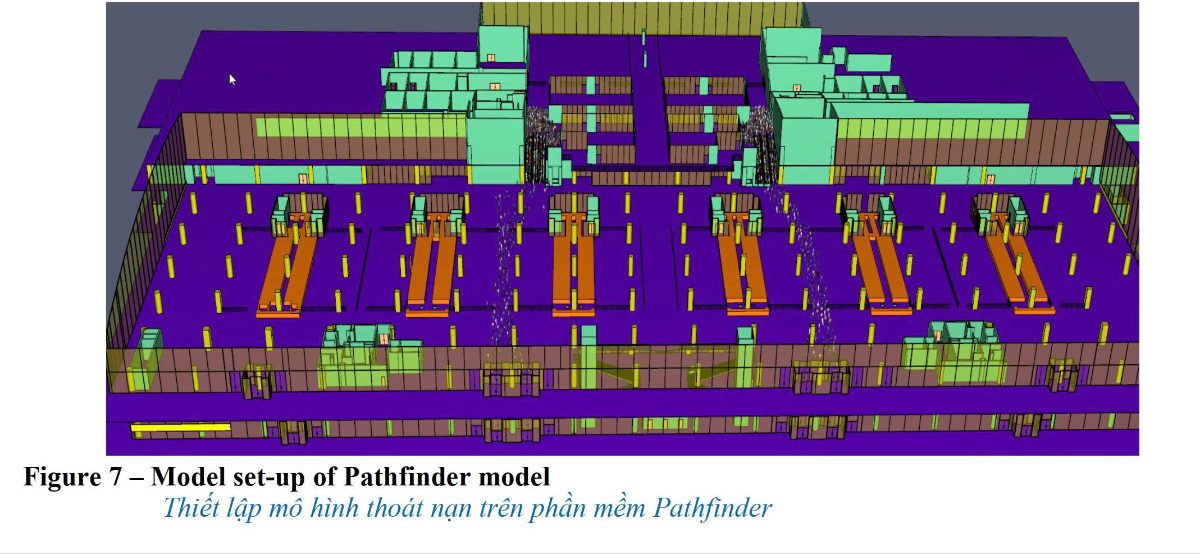
Pathfinder egress simulation model — Phu Quoc International Airport terminal
Pathfinder · Egress

Evacuation Simulation — Phu Quoc International Airport

Evacuation Simulation — Phu Quoc International Airport

Pathfinder model for the Phu Quoc airport terminal. The ASET/RSET calculation confirms safe egress conditions for passengers and staff under all design fire scenarios.

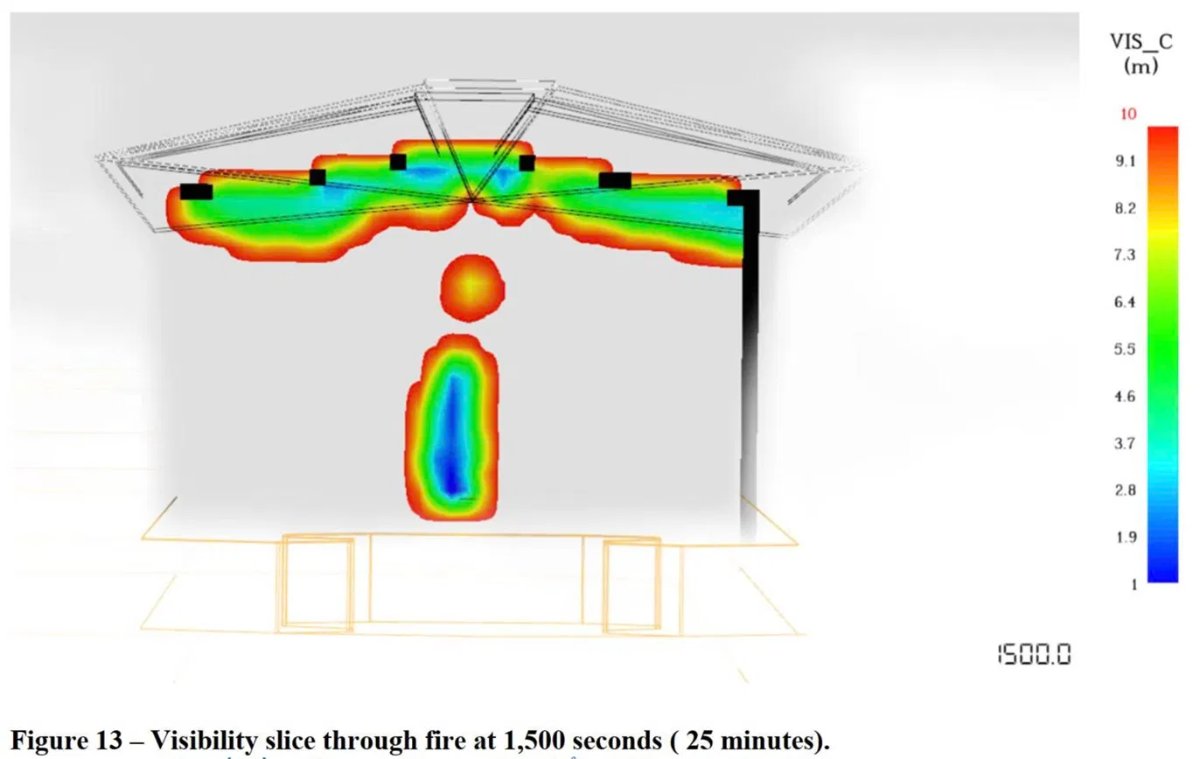
FDS fire and smoke simulation — visibility slice at 1500 seconds — Phu Quoc International Airport
FDS / PyroSim · Smoke

Fire & Smoke Simulation — Phu Quoc International Airport

Fire & Smoke Simulation — Phu Quoc International Airport

FDS simulation results showing visibility distribution at 1,500 seconds (25 minutes). The colour map demonstrates the effectiveness of the smoke control system in the large terminal space.

Case Studies — Real Projects

Real-project case studies

Egress & fire simulation

Phu Quoc International Airport

PHU QUOC · AVIATION · PATHFINDER + FDS

Pathfinder egress modelling and FDS fire simulation for the passenger terminal. ASET/RSET assessment and verification of large-volume smoke control system performance per NFPA 92 and BS 7974.

PathfinderFDS/PyroSimASET/RSETNFPA 92BS 7974

Technical justification & simulation

T2 Terminal Extension — Noi Bai Airport

HANOI · AVIATION · PBD + SIMULATION

Technical justification dossier and fire simulation for the Noi Bai T2 expansion. International code application, QCVN gap analysis, and dossier preparation for regulatory review.

Technical JustificationNFPA 101Gap AnalysisFire Simulation

Standards & Tools Applied

Standards & tools applied

FDS

Fire Dynamics Simulator — NIST (fire & smoke modelling)

Pathfinder

Thunderhead Engineering (egress modelling)

NFPA 5000

Building Construction and Safety Code

BS 7974

Application of fire safety engineering (UK)

SFPE Handbook

Society of Fire Protection Engineers

ISO/TR 16738

Fire safety engineering — Evacuation modelling

QCVN 06

National technical regulation on fire safety

Decree 105/2025

Fire Safety Law 55/2024 — Post-inspection regime

FAQ — Performance-Based Fire Design

Frequently asked questions

What are the steps in a performance-based fire design process?

The PBD process comprises: (1) Define performance objectives and design fire scenarios; (2) Fire & smoke simulation (FDS/PyroSim); (3) Egress simulation (Pathfinder/STEPS); (4) ASET vs RSET analysis — confirm safe egress conditions; (5) Prepare the technical justification report; (6) Defend the dossier when the competent authority requests a review.

When is PBD required for a project?

PBD and simulation are required when: (a) the project exceeds the QCVN 06 scope — towers above ~150 m, airport terminals, underground metro stations, LNG storage; (b) the owner wishes to demonstrate an alternative or superior solution; (c) smoke control or egress design optimisation is needed without additional cost. Fire Safety Law 55/2024 makes PBD a fully legitimate design approach within the post-inspection regulatory framework.

What are ASET and RSET and why do they matter?

ASET (Available Safe Egress Time) is the time from ignition until conditions become untenable — derived from FDS smoke simulation. RSET (Required Safe Egress Time) is the time needed for all occupants to reach safety — derived from Pathfinder modelling. Safe egress is demonstrated when ASET exceeds RSET by an appropriate safety factor.

Does your project require performance-based design?

VIETSAFE E&C has a team of engineers with real-world fire simulation experience on airport, high-rise, and metro projects in Vietnam.

Contact us now →